Product managers think about scale from day one. How does this feature work for 10 users? 10,000? 10 million?
Content operations rarely get that treatment. Agencies build processes for their current workload, then panic when growth happens.
From Freelance to Agency Thinking
Early in a freelance career, content workflows are personal. One website. One client. Processes live in your head.
When you take on 5 clients, you start documenting. 20 clients, you build systems. 100+ clients, you need automation.
The transition from “how I work” to “how we work” requires thinking in systems. Not individual projects. Systems that scale.
Key Metrics That Actually Matter
Most teams track vanity metrics. Posts published. Pages deployed. These don’t matter.
What matters:
– Time from approval to live (deployment speed)
– Errors per deployment (quality)
– Percentage of deployments on first try (process reliability)
– Cost per deployment (efficiency)
If approval-to-live takes 4 hours with a 10% error rate, that’s the system to fix. Not the content itself.
Design Principles for Scale
Eliminate manual steps. Every manual step is a failure point. Every failure point introduces delay and error.
Automate consistently. If you automate part of the process, automate all of it. Partial automation creates bottlenecks elsewhere.
Make it reversible. Build rollback capability. If deployment goes wrong, undo instantly. This confidence enables faster iteration.
Build for APIs. Future-proof by designing API-first. Direct content synchronization beats file export/import.
Measure everything. You can’t improve what you don’t measure. Track deployment metrics religiously.
The Content Broadcaster Origin Story
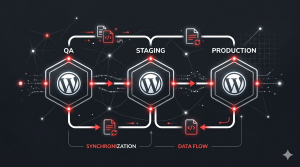
Building Content Broadcaster came from frustration. Every project repeated the same steps: export content, zip files, upload to production, pray nothing breaks.
The product started as an internal tool. “Let’s automate this.” Then it evolved: “What if we made this reusable? What if other agencies needed this?”
Designing for scale from the beginning—API connections, error handling, versioning—meant the tool could grow from one user’s need to many organizations’ standard.
Scaling Your Own Systems
Whether building tools or processes, ask: “How does this work at 10x our current size?”
That question drives better decisions today.